Advantages of Inclusion in Special Education: A Guide for Students and Schools

Advantages of Inclusion in Special Education
Inclusion in special education can help students feel welcomed, supported, and connected to their school community. Rather than treating students as problems to be managed, thoughtful inclusion gives students access to learning, relationships, and supports while respecting that every learner has different needs.
This guide explains what inclusion can look like, why it matters, and what schools can do to make it meaningful. It is based partly on Jimmy Clare’s lived experience as an autistic student and on the practical reality that no classroom approach works well when it is treated as one-size-fits-all.
Important note: Educational placements and supports should be decided individually with the student, family, educators, and qualified professionals. Inclusion should expand access and support, not remove accommodations a student needs.

What Is Inclusion in Special Education?
Inclusion is an approach in which students with disabilities learn alongside their peers in general education settings for all or part of the day, with the services, accommodations, modifications, and staffing they need. It is not simply putting someone in a room and hoping for the best. Real inclusion means planning for participation, belonging, communication, learning, and sensory or accessibility needs.
Students may participate in general education classes full time, part time, or through a mix of settings. The right arrangement depends on the student’s strengths, goals, preferences, and support needs.
When Did Special Education Inclusion Begin?
Modern U.S. special education protections grew from federal disability-rights law. The Education for All Handicapped Children Act was signed in 1975 and later became the Individuals with Disabilities Education Act (IDEA). The law established important rights to a free appropriate public education and education in the least restrictive environment for eligible students.
Inclusion has continued to develop as schools, families, and disabled advocates have pushed for classrooms that provide genuine access rather than isolation.
Why Is Inclusion in Education Important?
For many students, being included is about more than academics. It can mean having a predictable place in the school community, joining conversations with peers, and having opportunities to build friendships. It can also reduce the message that students who learn differently should be separated from everyone else.
That said, inclusion should never mean abandoning support. A student may need a quieter workspace, visual directions, assistive technology, an aide, targeted instruction, or time in a smaller setting. Good inclusion makes those supports available without making the student feel like an afterthought.
Key Advantages of Inclusion in Special Education
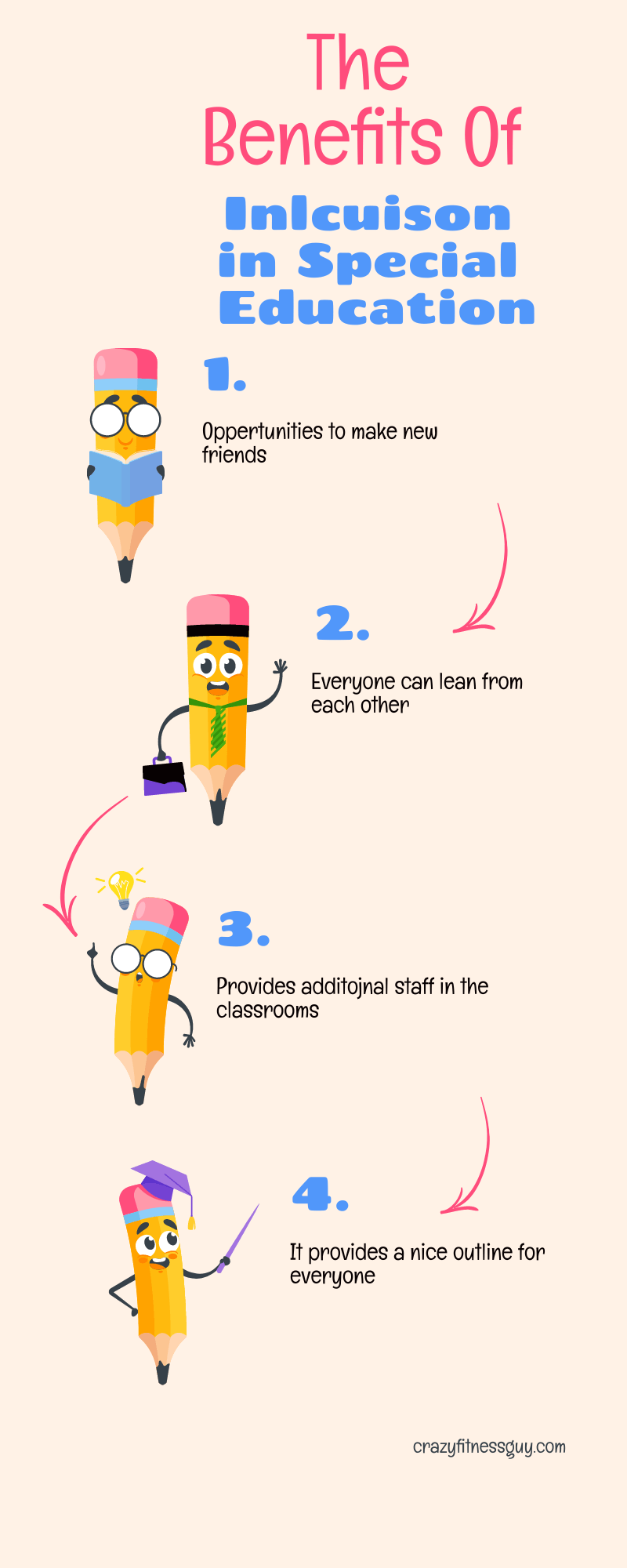
- More opportunities for connection: Students can build friendships and participate in the ordinary social life of school.
- Learning from different perspectives: Classrooms become stronger when students encounter different communication styles, abilities, cultures, and ways of solving problems.
- Shared access to supports: Clear routines, visual schedules, lecture outlines, and chunked instructions often help more than the students whose plans require them.
- More collaboration among adults: General educators, special educators, related-service providers, aides, and families can coordinate support instead of working in silos.
- A stronger sense of belonging: Students are more likely to engage when they know they are valued members of the class.
Opportunities to Build Friendships
Separate programs can feel safe and necessary for some needs, but they may also limit informal chances to meet peers. Inclusive classes give students more opportunities to work together, share interests, eat lunch, join projects, and form relationships over time.
Jimmy experienced how powerful that can be. Inclusion helped him build a long-term friendship with Adam, whose family accepted him as he was. Belonging is not a small extra; for many students, it is part of what makes school feel possible.
Learning From People Who Learn Differently
Students do not all learn best in the same way. One student may understand a lesson by listening, while another benefits from a diagram, written outline, demonstration, movement break, or repetition. When teachers use multiple ways to explain material, the whole class can benefit.
Predictable routines can be especially useful for autistic and neurodivergent students. For more ideas, read Autism, Routine, and Structure.
Additional Support in the Classroom
When support staff work as part of the classroom team, they can help facilitate small groups, clarify directions, provide check-ins, and support participation. The goal is not to hover over one student. It is to give the student the right support while preserving dignity, independence, and peer relationships.
Clearer Organization for Everyone
Tools such as lesson outlines, visual agendas, step-by-step directions, and advance notice of schedule changes are useful classroom practices. They reduce guesswork for students, educators, and support staff. Nobody should have to decode an entire school day like it is a confusing escape room.
Inclusion vs. Pull-Out Support
Inclusion and pull-out services are not opposites in every situation. Inclusion means the student participates in general education with appropriate support. Pull-out services mean the student receives specialized instruction or related services outside the general classroom for a defined period.
A student might be included in a general education class for most of the day and receive targeted reading, speech, occupational therapy, or other support elsewhere. The important question is whether the schedule supports the student’s learning and well-being—not whether a label sounds better on paper.
Types of Inclusion Programs
Full Inclusion
A student participates in the general education classroom for most or all of the school day and receives supports there as appropriate.
Part-Time Inclusion
A student joins general education for selected classes or activities and receives specialized instruction in other settings when that better matches their needs.
Push-In Support
A special educator, aide, or related-service provider comes into the general classroom to deliver support without routinely removing the student from peers.
Self-Contained Classrooms
A self-contained classroom offers a smaller, more specialized setting. For some students, it can be an important part of an individualized program. It should not be described as a failure of inclusion; the appropriate setting is the one that provides meaningful access, safety, support, and progress for the individual student.
Practical Inclusion Strategies
- Get to know each student’s communication style, strengths, goals, and sensory needs.
- Use clear routines, visual schedules, and advance notice of transitions whenever possible.
- Break assignments into smaller steps and check for understanding without singling students out.
- Offer multiple ways to participate, such as speaking, writing, drawing, using technology, or working with a partner.
- Build planned collaboration time between general educators, special educators, support staff, and families.
- Use tools such as recordings, captions, outlines, and accessible digital materials when they support learning.
- Teach peers about respect and disability inclusion without putting disabled students on display as a lesson.
Supporting students through bullying concerns is also part of building an inclusive environment. See Bullying Awareness Month for additional perspective.
Best Practices for Schools
Provide Ongoing Training
Educators need time and training to use inclusive practices well. That includes accessible instruction, behavior support, communication differences, sensory needs, scheduling, and collaboration. Training should be practical and continuous, not a single checkbox session at the beginning of the year.
Fund Staffing and Materials
Inclusion requires resources. Schools need adequate staffing, planning time, accessible materials, assistive technology when appropriate, and support for teachers. Asking educators to create fully inclusive classrooms without time or funding is not a plan—it is wishful thinking with a budget problem.
Center the Student’s Voice
Students should have a meaningful voice in conversations about what helps them learn. Families and school teams should listen to students’ preferences, especially around sensory needs, communication, transitions, and the supports that help them participate with confidence.
Common Myths About Inclusion
Myth: Inclusion only benefits disabled students.
Reality: Inclusive practices such as clear instructions, varied teaching methods, and supportive classroom culture can benefit many learners. Inclusion also gives all students experience interacting respectfully with people whose needs and experiences differ from their own.
Myth: Inclusion means every student must stay in one setting all day.
Reality: An inclusive, individualized program may include general education participation plus specialized instruction or services in another setting. The support plan should fit the student.
Myth: Inclusion works without planning or resources.
Reality: Placement alone does not create belonging. Effective inclusion requires staff coordination, accessibility, training, and the flexibility to adjust when a student’s needs change.
For a related discussion, visit The Challenges of Special Education.
Conclusion
The advantages of inclusion in special education go beyond academics. When it is individualized, well-supported, and built around respect, inclusion can help students access learning, relationships, and a stronger sense of belonging. The goal is not to force everyone into the same mold. The goal is to make school more accessible so every student has a real chance to participate and grow.
Keep Learning With CrazyFitnessGuy
CrazyFitnessGuy is an autistic-led resource for practical, respectful guidance that does not pretend every person needs the same solution. Explore the CrazyFitnessGuy blog for more autism, well-being, and personal-growth content.
Stay Motivated and Inspired by Subscribing to Our Monthly Newsletter!

Founder
Jimmy Clare is a Professional Keynote Speaker, Podcaster, Live Stream Host, and Autism Advocate who founded CrazyFitnessGuy® in 2017 to share healthy living through autistic eyes. He combines his lived experience with autism and his own health journey to encourage others to embrace their uniqueness and build sustainable habits.

How Group Fitness Supports Work-Life Balance





